Airspace Closures Disrupt Key Westbound Routes
Rising tensions in the Middle East have disrupted global aviation. Several countries have closed their airspace, including Iran, Iraq, Kuwait and Israel. These closures have blocked the main northern corridor used for India–Europe overflights. As a result, Indian carriers cancelled nearly 350 flights on Sunday, according to the Ministry of Civil Aviation. Airlines are now exploring southern deviations and technical stopovers to maintain operations. The situation remains fluid, and further changes may follow if restrictions continue.
Air India Protects North America Operations
Air India confirmed that its flights to North America will operate as scheduled from Monday. It remains the only Indian carrier flying directly to the US. However, the airline cancelled 50 international services on Sunday. Some Europe-bound flights were also suspended. Services to John F. Kennedy International Airport and Newark Liberty International Airport will now include technical stops at Leonardo da Vinci–Fiumicino Airport. These alternative routes will increase flying time. The airline said the changes are necessary to ensure passenger safety and continuity.
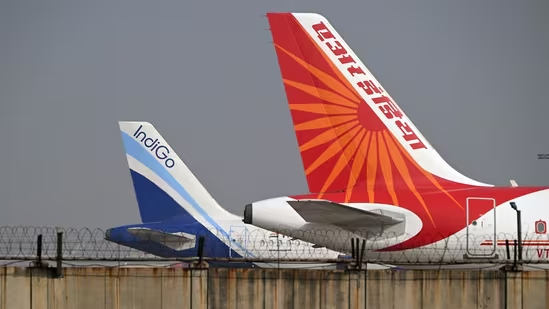
IndiGo Cancels 360 Flights, Extends Waivers
IndiGo cancelled around 360 flights until March 3. The airline also introduced flexible rebooking options and waiver policies for affected travellers. Industry experts estimate weekly losses of nearly ₹875 crore for Indian and international airlines. Airspace closures over Pakistan, Iran and the UAE have blocked key westbound routes. Avoiding the Middle East increases fuel consumption and crew costs. Flight durations may extend by at least two hours.
Metro Airports Under Pressure
Major airports are feeling the impact. Mumbai recorded 160 cancellations and briefly stopped accepting diversion traffic due to limited parking bays. Delhi saw 23 cancellations and handled five diverted flights. Bengaluru, Hyderabad, Chennai and Kolkata also reported disruptions. Aviation officials say airlines are making operational decisions daily. Despite the uncertainty, carriers aim to preserve connectivity to the US and Europe while managing one of the region’s toughest airspace crises in recent years. remain focused on preserving essential connectivity to the US and Europe while navigating one of the region’s most challenging airspace crises in recent years.