Modi, EU Leaders Anchor Trade Against Protectionism
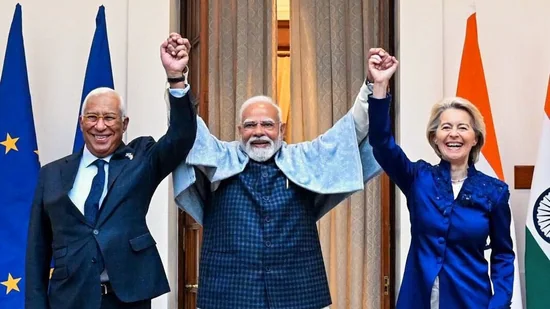
Prime Minister Narendra Modi and European Union leaders on Tuesday announced a historic India-EU Free Trade Agreement, branding it the “mother of all deals.” The agreement marks a decisive push against rising protectionism and trade uncertainty. Modi hosted European Council President Antonio Costa and European Commission President Ursula von der Leyen at the India-EU Summit in New Delhi. The announcement followed the EU leaders’ participation as chief guests at India’s Republic Day celebrations, an honour reserved for close strategic partners. Leaders framed the pact as a pillar of a rules-based global order and a signal of long-term strategic trust.
Tariff Cuts Open Vast Market for Goods and Industry
The agreement delivers sweeping tariff reductions on both sides. The EU will eliminate tariffs on 99% of Indian exports by value over seven years. Duties on $33 billion worth of labour-intensive goods, including textiles, leather, footwear, gems and jewellery, will drop immediately. India will reduce tariffs on 96.6% of EU exports, with nearly one-third of cuts taking effect from day one. European car tariffs will fall from 110% to 10% for up to 250,000 vehicles annually. Wine and spirit duties will also see sharp reductions. Officials expect the pact to save exporters €4 billion each year and generate millions of jobs.
Services, Investment and Supply Chains Get Major Boost
Modi called the FTA the largest trade deal in India’s history, noting bilateral trade already totals €180 billion. Indian service firms will gain access to 144 EU sub-sectors, while India opens 102 segments to European providers. The deal expands opportunities in IT, education, consulting and professional services. Both sides agreed to cooperate on supply chains, innovation and investment. On the EU’s carbon border levy, officials committed to technical dialogue to protect Indian market access and ensure regulatory alignment.
Trade Deal Strengthens Security and Strategic Ties
India and the EU paired the trade pact with a new Security and Defence Partnership. The agreement deepens cooperation in counter-terrorism, maritime security, cyber defence and military co-development. Leaders also finalised a mobility framework to ease movement for students, researchers and skilled workers. A joint “Towards 2030” roadmap will guide cooperation in green transition, AI, semiconductors and connectivity. Leaders plan to sign the agreement formally in August 2026. The pact will become operational in early 2027, ending nearly two decades of negotiations.