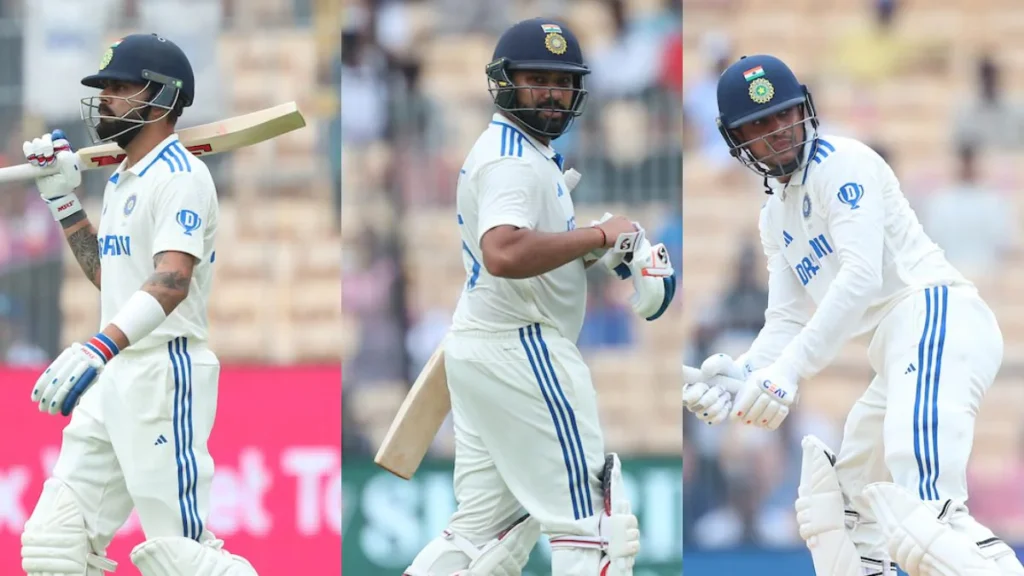
Virat Kohli, Rohit Sharma Role Reversal Under Shubman Gill Signals ODI Shift
India’s ODI batting dynamics have undergone a clear transformation since Shubman Gill took over as captain, and the contrast between Rohit Sharma and Virat Kohli sits at the heart of it. Rohit’s ODI identity has long centred on early dominance. As captain, he set the tone aggressively, operating at a strike rate of 111.97, which reflected India’s front-loaded attacking blueprint. However, since the leadership transition, Rohit’s approach has shifted noticeably—not due to declining form, but because of a recalibrated role within the batting order.
Numbers Reveal a Clear Change in Tempo
The statistical contrast before and after the captaincy handover is striking. During Rohit’s tenure as ODI captain, Kohli scored at 94.67, playing the anchor while Rohit attacked early. In the post-handover phase—covering the Australia ODIs in 2025, South Africa ODIs in 2025, and the New Zealand opener in 2026—Rohit has scored 374 runs off 397 balls (SR 94.21). Meanwhile, Kohli has amassed 469 runs off 442 balls (SR 106.11). That swing represents a drop of nearly 18 runs per 100 balls for Rohit and a rise of over 11 runs per 100 balls for Kohli, underlining a meaningful redistribution of scoring responsibility.
Rohit Adopts Control as Kohli Sharpens Acceleration
Rohit’s slower strike rate does not reflect hesitation. Instead, it reflects context-driven batting. His 73 off 97 in Adelaide and 121 off 125 in Sydney* show an emphasis on stability rather than powerplay blitzes. Even in South Africa, Rohit mixed bursts—57 off 51, 75 off 73—with longer innings designed to absorb pressure. Aggression now appears conditional, deployed when the situation allows rather than as a default setting.
Kohli, in contrast, has shifted gears. Despite early failures in Australia, he finished the phase with a strike rate above 106. His South Africa knocks—135 off 120, 102 off 93, and 65 off 45*—reflect a batter accelerating earlier and sustaining tempo through the middle overs. The 93 off 91 against New Zealand reinforced that trend.
What It Means for India’s ODI Blueprint
The evidence points to a structural evolution under Gill. India no longer relies solely on early dominance. Instead, Rohit provides insurance and shape, while Kohli now drives tempo through the middle overs and into the finish. In essence, Rohit has slowed materially as responsibility shifted, while Kohli has embraced a sharper scoring role. The data supports it clearly—India’s ODI innings allocation has changed, and the results suggest a deliberate, calculated transition.
— Zoom Chronicle News